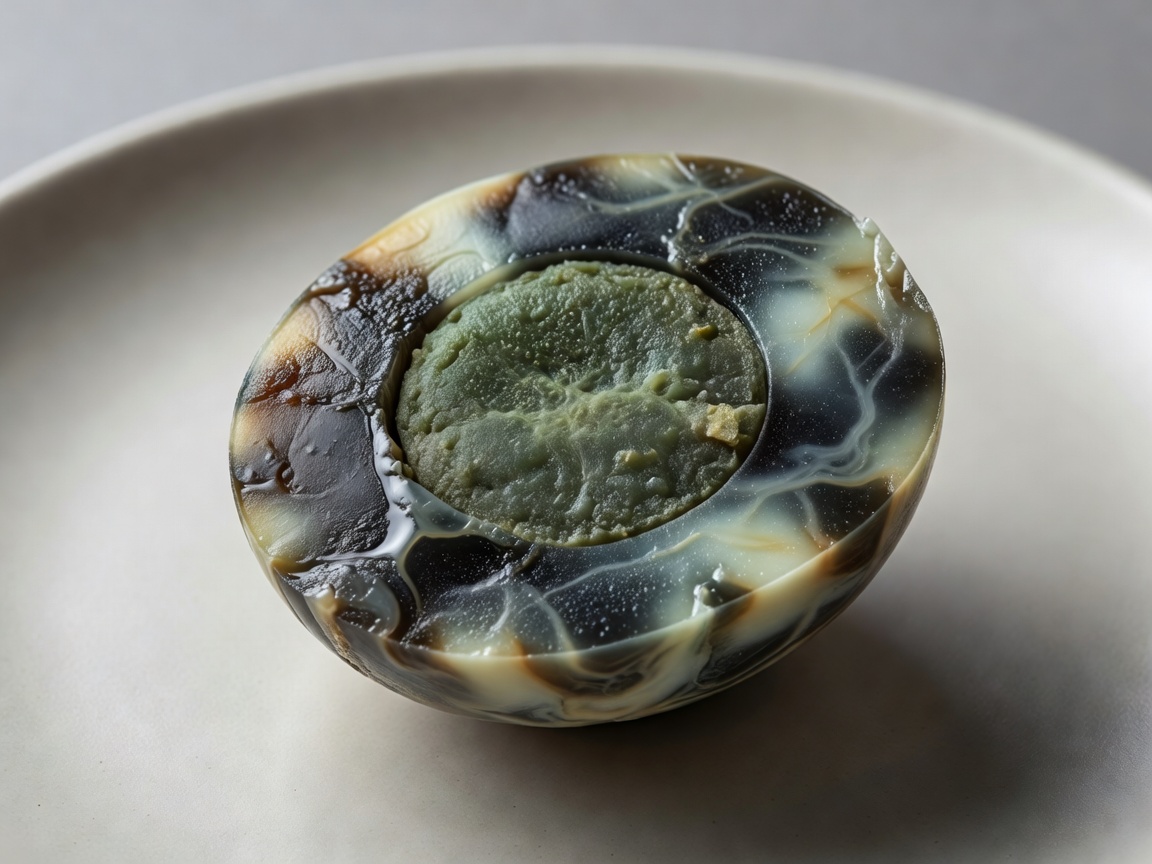
Century Egg (also known as Pidan, Preserved Egg, or Thousand-Year Egg) is a Chinese preserved food product made by curing duck, chicken, or quail eggs in a mixture of clay, wood ash, salt, quicklime, and strong black tea for several weeks to several months.
The Alkaline Chemical Transformation
Contrary to Western urban myths suggesting eggs are soaked in horse urine, Pidan is created purely through inorganic alkaline chemical reactions. The quicklime (calcium oxide) and wood ash raise the pH of the egg to around 9 to 12. This high alkalinity breaks down proteins and fats inside the egg without boiling.
The sodium hydroxide formed during the process denatures the egg white proteins into a firm, translucent dark amber gel. Meanwhile, hydrogen sulfide and ammonia produced by amino acid breakdown transform the yolk into a dark green, creamy center with rich umami depth.
Key Characteristics & Patterns
Pine Needle Patterns (Songhua): Fine, crystalline branch-like patterns often appear on the translucent egg white, formed by crystallized tyrosine amino acid salt.
Flavor & Aroma: Pungent ammonia and sulfur fragrance with a velvety, complex, savory umami taste.
Traditional Serving: Sliced into wedges and served with fresh pickled ginger root, soy sauce, and sesame oil, or stirred into pork congee porridge.
Historical Roots
Legend traces Pidan back to the Ming Dynasty in Hunan province, where a homeowner discovered duck eggs preserved naturally in a pool of slaked lime leftover from house construction. Upon tasting them, he perfected the recipe by adding salt and tea infusion, establishing a preservation method still practiced today.