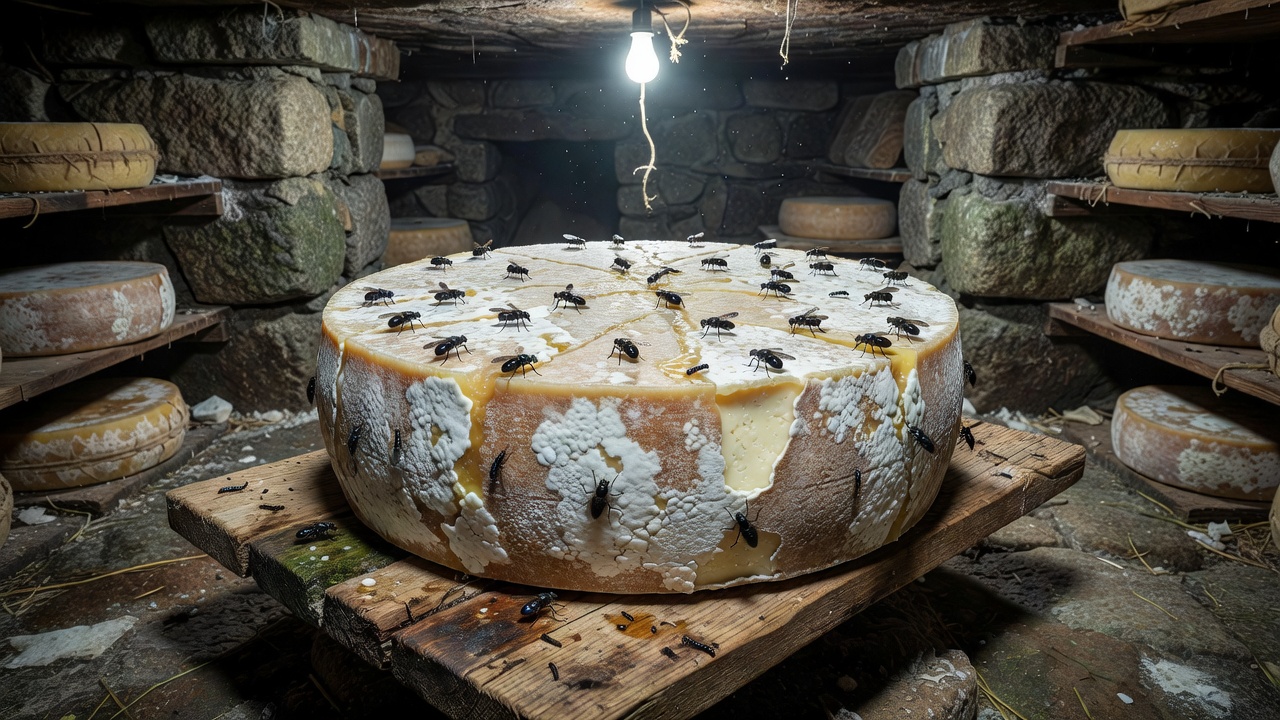
Casu Marzu (literally translating to "rotten cheese" in the Sardinian language) represents one of the most extreme frontiers of artisanal dairy fermentation in human history. Native to the Mediterranean island of Sardinia, this sheep's milk cheese goes well beyond typical mold-driven aging into active insect decomposition.
The Biochemical Alchemy
The creation process begins with Pecorino Sardo. Cheesemakers intentionally leave wheels of Pecorino outdoors with parts of the rind removed to invite the cheese fly (Piophila casei) to lay hundreds of eggs inside the cheese matrix. Upon hatching, thousands of translucent larvae feed on the milk fats and proteins.
The digestive enzymes produced by these maggots break down the fats at an accelerated rate, turning the firm cheese into a soft, liquid texture called lágrima ("teardrop"). By the time it is consumed, a single wheel of Casu Marzu contains thousands of active, wriggling larvae.
Safety Warning & Legal Status
European Union hygiene regulations banned Casu Marzu under EU Food Hygiene Legislation (EC Regulation No. 178/2002) due to health risks such as enteric pseudomyiasis (larvae surviving stomach acid). However, local Sardinian shepherds continue traditional small-scale production under heritage exemptions.
Flavor Profile & Cultural Ritual
Sardinians who consume Casu Marzu describe its flavor as intensely pungent, burning the tongue with a spicy, ammonia-laden aftertaste that lingers for hours. It is traditionally spread onto moistened Sardinian flatbread (pane carasau) and enjoyed alongside a glass of strong Cannonau red wine.
Dineman must protect their eyes while eating: when disturbed, the larvae can jump up to 6 inches (15 cm) into the air, making eye protection or shielding hands necessary during consumption.